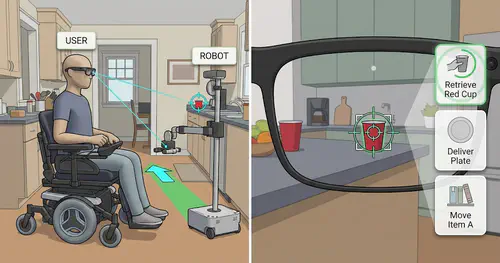
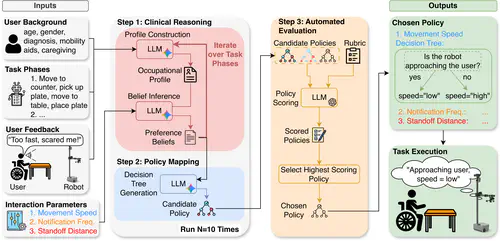
We bring gaze-guided task suggestion for assistive robots into longitudinal clinical deployments with people living with ALS, spinal cord injuries or Parkinson’s disease. By tracking how motor degeneration affects egocentric gaze and head coordination over time, we adapt our filtering and visual-language algorithms to tolerate pathological gaze noise such as jitter, saccadic intrusions and fixational drift.