SpatialMind: Spatially Aware On-Device Embodied AI via Viewpoint Integration
Abstract
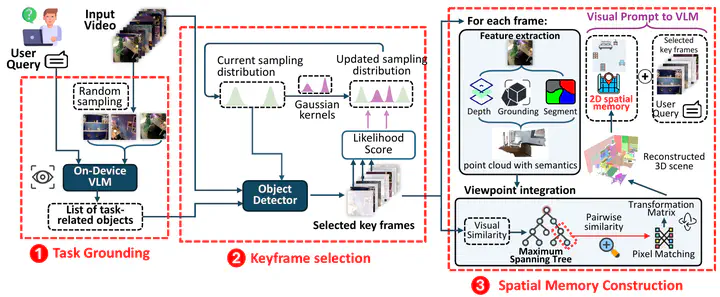
On-device embodied AI allows local processing of visual data and prompt responses to user requests. Applying embodied AI to more complex domains requires spatial cognition, to properly comprehend the 3D environment and geometric relations between objects. However, existing vision-language models (VLMs) are weak in spatial cognition due to their limitations to 2D image understandings. In this paper, we present SpatialMind, a new on-device embodied AI technique that bridges the gap between 2D visual inputs and 3D physical reality, by injecting 3D spatial knowledge into on-device VLMs in a sparse form of 2D allocentric spatial memory. This memory is constructed by systematically aligning cross-frame visual features to a unified global viewpoint, and we prune the scope of on-device computation to maximize the compute efficiency in memory construction and VLM reasoning. Experiment results in diverse indoor environments show that SpatialMind greatly enhances the performance of spatially aware on-device embodied AI tasks, with high adaptability, robustness and compute efficiency.
An earlier version of this work is available on arXiv as MosaicThinker: On-Device Visual Spatial Reasoning for Embodied AI via Iterative Construction of Space Representation.