Low-Burden LLM-Based Preference Learning: Personalizing Assistive Robots from Natural Language Feedback for Users with Paralysis
Abstract
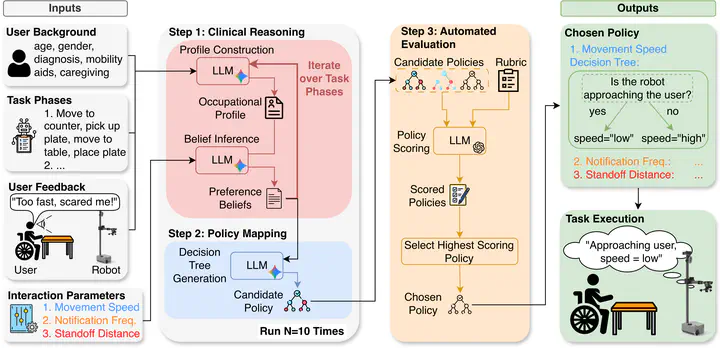
Physically Assistive Robots require personalized behaviors to ensure user safety and comfort. However, traditional preference learning methods, like exhaustive pairwise comparisons, cause substantial physical and cognitive fatigue for users with severe motor impairments. To solve this, we propose a low-burden, offline framework that translates unstructured natural language feedback directly into deterministic robotic control policies. To safely bridge the gap between ambiguous human speech and robotic code, our pipeline uses Large Language Models (LLMs) grounded in the Occupational Therapy Practice Framework. This clinical reasoning decodes subjective user reactions into explicit physical and psychological needs, which are then mapped into transparent decision trees. Before deployment, an automated “LLM-as-a-Judge” verifies the code’s structural safety. We validated this system in a simulated meal preparation study with 10 adults with paralysis. Results show our natural language approach significantly reduces user workload compared to traditional baselines. Additionally, occupational therapists confirmed the generated policies are safe and accurately reflect user preferences.

Keshav Shankar
PhD Student