DrGait: Biomechanically Grounded Visual Reasoning for Interpretable Clinical Gait Analysis
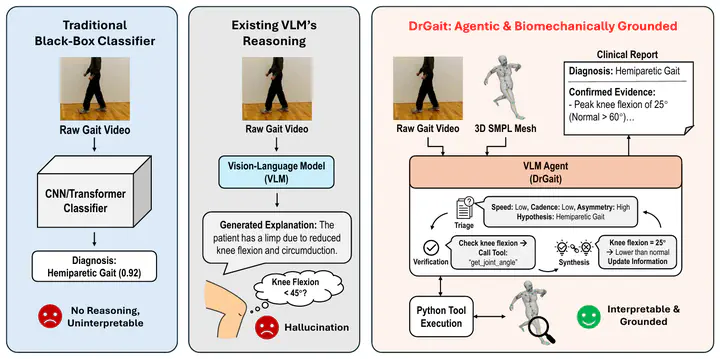 High-level comparison between existing gait analysis methods and DrGait
Abstract
Current automated gait analysis for clinical applications relies on uninterpretable black-box classifiers. Although Vision-Language Models (VLMs) offer strong reasoning capabilities, applying them directly to gait videos often leads to hallucinations, because they struggle to measure subtle geometric deviations from raw visual contexts. To address this, we introduce DrGait, a training-free agentic framework that shifts the VLM’s role from a direct visual reasoner to a clinical planner. DrGait decouples semantic reasoning from geometric perception through a structured Triage-Verification-Synthesis (TVS) workflow. Given an input video and a set of basic spatiotemporal metrics, the DrGait agent first performs a heuristic triage to propose diagnostic hypotheses, which are then verified by autonomously calling deterministic biomechanical tools that operate on reconstructed 3D mesh trajectories, segmented 2D pose tracks, and event-centered video evidence. Finally, a closed-loop mechanism recursively updates the agent’s reasoning context based on the feedback. By anchoring VLM’s reasoning in verifiable geometric and temporal measurements, DrGait reduces hallucinations, achieving competitive diagnostic accuracy while generating transparent and audit-ready clinical reports.